
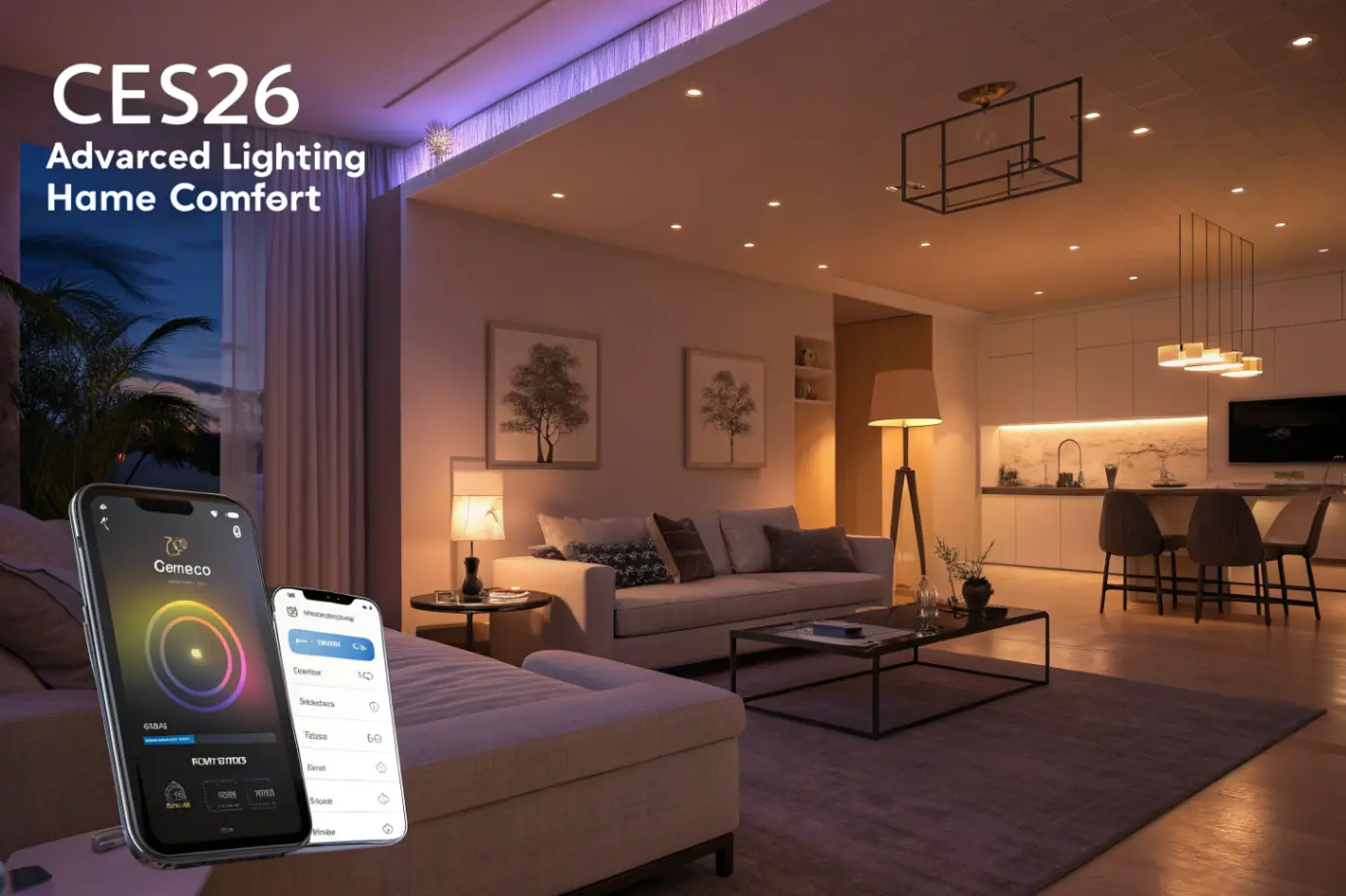
The conversation around smart homes has shifted dramatically over the past few years. What once focused on voice assistants and connected speakers is now centered on intelligent environments — spaces that respond to human presence, mood, health, and daily rhythm. At CES 2026, smart lighting and comfort-driven accessories stood out as some of the most practical and impactful innovations. From AI-powered adaptive lighting systems to sensor-based accessories that quietly optimize indoor environments, manufacturers showcased products designed not just for convenience, but for measurable improvements in everyday comfort.
This article explores the most important smart lighting trends at CES 2026 and the new generation of home comfort accessories redefining modern living.
AI-Powered Smart Lighting Systems at CES 2026
One of the most discussed themes at CES 2026 was AI-powered smart lighting. Unlike previous generations that relied on simple app control or scheduled timers, the new wave of smart home lighting systems uses machine learning algorithms to analyze behavioral patterns, natural light exposure, and even biometric data.
Major brands introduced adaptive lighting ecosystems capable of adjusting color temperature and brightness automatically throughout the day. These systems sync with wearable devices to align lighting conditions with circadian rhythms, improving sleep quality and reducing eye strain. Instead of manually selecting “warm” or “cool” presets, users now experience lighting that evolves dynamically based on real-time inputs.
Another breakthrough was hyper-localized lighting control. Using advanced motion sensors and mmWave presence detection, lights respond to subtle movements — not just room entry. This allows illumination to follow users from workspace to kitchen to living room, minimizing energy waste and maximizing convenience.
Energy efficiency also took center stage. Several companies revealed smart LED panels that consume up to 40% less power compared to 2024 models while delivering higher lumen output. Integration with home energy management systems enables real-time monitoring of lighting consumption, helping households reduce electricity costs.
CES 2026 clearly demonstrated that smart lighting is no longer an add-on. It has become a foundational component of the intelligent home ecosystem.
Key Smart Lighting Products Launched at CES 2026
The exhibition floor featured a wide array of smart lighting solutions, from minimalist designer fixtures to modular, fully customizable lighting grids. Before reviewing the standout devices, it is helpful to compare their core specifications and innovations.
| Product Name | Core Feature | Connectivity | Unique Innovation | Target Use |
|---|---|---|---|---|
| Lumina AI Panel | Adaptive circadian lighting | Matter + Wi-Fi 7 | AI mood detection | Living rooms & offices |
| HaloSense Ceiling Grid | mmWave presence detection | Zigbee + Thread | Zone-follow lighting | Large open spaces |
| PureGlow Pro Lamp | Health-oriented spectrum tuning | Bluetooth LE + Wi-Fi | Blue light optimization | Bedrooms |
| TerraLight Outdoor | Weather-reactive automation | 5G IoT module | Climate-responsive brightness | Outdoor patios |
| NovaBeam Strip 2.0 | Modular magnetic light strips | Matter | Gesture-based control | Kitchens & creative studios |
The Lumina AI Panel attracted attention due to its integrated AI mood detection. By analyzing voice tone and room activity, it adjusts lighting to enhance relaxation or focus. Meanwhile, HaloSense demonstrated advanced zone-follow lighting, which automatically transitions brightness levels based on user movement patterns.
PureGlow Pro emphasized wellness by fine-tuning blue light exposure in the evening to promote melatonin production. Outdoor solutions like TerraLight showed that smart lighting trends extend beyond interiors, offering climate-responsive brightness that adapts to fog, rain, or extreme sunlight.
These product launches highlight the growing convergence of lighting, AI, and wellness technology. The emphasis is no longer purely aesthetic — it is functional, data-driven, and personalized.
Smart Home Accessories That Elevate Everyday Comfort
While lighting dominated headlines, CES 2026 also introduced a new category of smart home accessories focused on passive comfort enhancement. These devices work quietly in the background, optimizing air, temperature, ergonomics, and sensory balance.
Manufacturers showcased compact smart diffusers that sync with lighting scenes, releasing calming scents when relaxation mode is activated. Intelligent curtain systems now integrate light sensors and weather forecasts, adjusting opacity to maintain ideal indoor brightness and temperature. Heated floor modules powered by AI thermostats demonstrated micro-zoning capabilities, warming only occupied areas.
To better understand how these accessories improve daily life, consider the following innovations presented at CES 2026:
-
AI-synchronized aroma diffusers that adapt scent intensity based on stress detection.
-
Smart thermal cushions with automatic posture correction sensors.
-
Adaptive blackout blinds that reduce glare and regulate indoor temperature.
-
Ultrasonic humidifiers linked to air quality analytics.
-
Wireless ambient sound panels that reduce echo while enhancing acoustic clarity.
Each of these devices integrates seamlessly into broader smart home ecosystems. The key development in 2026 is interoperability. Thanks to Matter protocol adoption, users can connect lighting, air control, and comfort accessories under one unified system without compatibility issues.
Importantly, these products focus on subtle enhancements rather than flashy automation. Comfort is now defined by environmental precision — balanced humidity, optimal illumination, reduced noise, and ergonomic support.
The Role of Matter and Wi-Fi 7 in Smart Lighting Evolution
Connectivity standards were a major topic at CES 2026. With Wi-Fi 7 becoming mainstream and Matter protocol gaining universal support, smart lighting and accessories are more stable and responsive than ever.
Wi-Fi 7 offers significantly lower latency and improved bandwidth efficiency. This allows real-time synchronization between lighting, sensors, and AI assistants. For example, gesture-based lighting strips respond instantly without lag, and cloud-based analytics update lighting profiles within milliseconds.
Matter continues to simplify smart home integration. Instead of juggling multiple apps, users can manage all connected lighting and comfort accessories from a single interface. Interoperability also encourages ecosystem expansion, making it easier for homeowners to adopt new devices over time.
Security enhancements were another highlight. End-to-end encryption and local processing capabilities reduce data vulnerability. Several CES exhibitors emphasized on-device AI processing, ensuring that personal behavioral data does not leave the home network.
The combination of Matter and Wi-Fi 7 represents a structural upgrade for the smart home industry. It eliminates friction and increases reliability — two factors that historically slowed adoption.
Wellness-Focused Lighting and Human-Centric Design Trends
A recurring theme across CES 2026 smart lighting announcements was human-centric lighting. Designers and engineers are increasingly incorporating biological and psychological principles into lighting solutions.
Circadian lighting systems now track sunrise and sunset patterns based on geographic location. Instead of static presets, they dynamically adjust spectrum intensity to mimic natural daylight cycles. This approach improves focus during working hours and supports deeper sleep at night.
Another emerging trend is emotional lighting. AI algorithms analyze room acoustics, user voice input, and even facial recognition data (processed locally) to modify ambient conditions. For example, cool white tones may shift to warmer hues when the system detects evening relaxation behavior.
Design aesthetics also evolved. Minimalist light panels with edge-to-edge diffusion technology reduce glare while providing uniform brightness. Transparent OLED lighting strips blend into architectural surfaces, transforming walls and ceilings into ambient light sources without visible fixtures.
Sustainability remained central to product design. Manufacturers introduced recyclable aluminum frames, biodegradable packaging, and energy-saving micro-LED arrays with extended lifespans exceeding 50,000 hours.
These advancements indicate that smart lighting in 2026 is not just about automation — it is about aligning technology with human biology and environmental responsibility.
Future Outlook: What CES 2026 Signals for Smart Homes
The innovations presented at CES 2026 suggest that the next phase of smart home evolution will focus on invisible intelligence. Rather than showcasing dramatic visual transformations, brands are investing in subtle environmental optimization.
Smart lighting systems will continue to integrate deeper AI personalization. We can expect predictive illumination patterns that anticipate user routines based on long-term data analysis. Accessories such as smart diffusers, adaptive blinds, and thermal comfort modules will likely become standard components of mid-range home installations.
Another important trend is modularity. Many products revealed at CES 2026 were designed to expand incrementally. Users can start with a single smart lighting panel and gradually build a synchronized ecosystem.
Affordability is also improving. As Matter adoption increases and hardware costs decline, entry-level smart lighting kits are expected to reach mainstream pricing within the next year.
Ultimately, CES 2026 demonstrated that smart lighting and comfort accessories are transitioning from luxury gadgets to essential infrastructure. Homes are becoming responsive environments — spaces that actively contribute to productivity, relaxation, and well-being.
Conclusion
CES 2026 showcased a mature smart home market driven by AI-powered smart lighting, interoperable ecosystems, and wellness-focused accessories. Innovations such as adaptive circadian lighting, mmWave presence detection, climate-responsive outdoor illumination, and AI-synchronized comfort devices illustrate a clear direction: technology should quietly enhance everyday life.
As connectivity standards like Matter and Wi-Fi 7 solidify, the smart lighting industry is entering a phase of stability and scalability. For homeowners seeking to improve comfort, efficiency, and personalization, the solutions presented at CES 2026 signal a transformative shift toward intelligent living environments.